PDF to JPG API
The PDF to JPG API converts PDF pages to JPG images with one API call. Upload a PDF or pass a link to one, choose the pages, the resolution and the JPG quality, and get each page back as a JPG: base64-encoded in JSON, with the page's size and text, or as a .jpg file.
PDF to JPG is served by the PDF to Image API endpoint /v1/pdftoimage with format=jpg, the default, so every example on this page uses format=jpg.
Each page counts as 10 API calls against your monthly quota. Requests that fail are not counted, and the X-Api-Calls-Charged response header shows how many API calls each request used. See pricing.
When to Choose JPG
JPG is the most widely supported image format, and it keeps files small for scanned pages and pages with photos. Choose it for thumbnails and previews, document viewers, email and chat attachments, and as input for OCR.
JPG compression can leave faint artifacts around sharp text and thin lines. For pixel-exact text, line art and diagrams, choose PNG (lossless, larger files); for the smallest files on the web, choose WebP. Both are covered on the PDF to Image API page.
Quality and File Size
quality (1 to 100, default 85) sets how strongly each JPG is compressed. 85 keeps text crisp on screen at a moderate size. Going down to 60 makes a typical text page roughly a quarter smaller, with softer edges around letters; going up to 95 makes it roughly a third larger. Quality 100 makes much larger files for little visible gain.
Resolution costs more than quality: each step up in dpi adds pixels, and doubling the DPI roughly triples the size of a text page. Use 72 DPI for thumbnails, the default 150 DPI for reading on screen, and 300 DPI for printing or OCR.
JPG Size per Page
Typical sizes for a text page at the default quality=85:
| dpi | US Letter page | Typical JPG size |
|---|---|---|
72 | 612 x 792 px | 75 to 120 KB |
150 | 1275 x 1650 px | 250 to 350 KB |
300 | 2550 x 3300 px | 700 to 900 KB |
Pages with large photos or dark backgrounds come out larger, and mostly blank pages smaller. One response carries up to about 4 MB of images, so at 300 DPI around four text pages fit; continue from next_page for the rest.
Which Quality to Use
| quality | Good for |
|---|---|
60-75 | Thumbnails, previews and large batches where size matters most |
85 | Reading on screen and OCR (default) |
90-95 | Printing and archiving |
Related APIs
- PDF to Image API - PDF pages to JPG, PNG or WebP images
- Image to PDF API - JPG, PNG and other images to one PDF
- JPG to PDF API - JPG photos and scans to one PDF
- Image to Text API - Read the text in an image (OCR)
https://api.api-ninjas.com/v1/pdftoimage
Converts the pages of a PDF to JPG images. Returns each page as a base64 image with its size and its text, or one page as a raw image file. Accepts GET or POST: use POST to upload the PDF, or GET with url.
Parameters
Send the PDF in one of three ways: as file (a multipart form upload), as url, or as the raw request body with Content-Type: application/pdf (up to about 4 MB). The other parameters can be query parameters or multipart form fields.
fileoptionalThe PDF, as a multipart form upload (
multipart/form-data), up to about 4 MB. Send one PDF per request.urloptionalA public
http://orhttps://link to the PDF, up to 25 MB, e.g.https://example.com/report.pdf. Works with GET or POST.pagesoptionalThe pages to convert: one page (
1), a range (2-5), a list (1,3,7-9) or a range to the end (4-, page 4 to the last page). Page 1 is the first page. Default: every page, up to 10 per request (see limits).formatoptionalImage format:
jpg(default),pngorwebp. The examples on this page useformat=jpg; see the PDF to Image API for PNG and WebP.dpioptionalResolution in dots per inch, from
30to300. Default150. At 150 DPI a US Letter page is about 1275 x 1650 pixels; at 300 DPI, 2550 x 3300.qualityoptionalImage quality for
jpgandwebp, from1to100. Default85. Lower values make smaller files with more compression artifacts. Ignored forpng, which is lossless.passwordoptionalThe password of a password-protected PDF.
Headers
X-Api-KeyrequiredAPI Key associated with your account.
Acceptoptionalimage/jpegorimage/*returns the first requested page as a raw image file instead of JSON.Content-Typeoptionalapplication/pdfwhen the request body is the PDF itself. Multipart uploads set their own content type.
Response
The /v1/pdftoimage endpoint returns a JSON object with the following fields, or an error if the request is unsuccessful (see errors).
page_countNumber of pages in the PDF.
next_pageThe next requested page that is not in this response, because of the per-request limits, or
nullwhen every requested page was returned. To continue, send the same request withpagesstarting atnext_page, e.g.pages=11-.pagesThe converted pages, in the order requested, each with the fields below.
pages[].pagePage number in the PDF (1 is the first page).
pages[].formatjpg,pngorwebp.pages[].width, pages[].heightImage size in pixels.
pages[].textThe text on the page, as plain text. Empty for scanned pages, whose text is part of an image; to read those, send the page image to the Image to Text API.
pages[].imageThe image file, base64-encoded.
With an image Accept header, the response body is the raw image of the first requested page, with Content-Type image/jpeg. Every successful response has an X-Api-Calls-Charged header with the number of API calls the request counted.
Limits
- Up to 10 pages per request.
- Each response carries up to about 4 MB of images. At high DPI fewer pages fit (around four text pages at 300 DPI); the rest are left for the next request, from
next_page. - Pages wider or taller than 5,000 pixels, or larger than 12 megapixels, at the requested DPI are scaled down to fit.
- Uploads up to about 4 MB; PDFs from
urlup to 25 MB.
API Calls
Each page returned counts as 10 API calls: a response with 3 pages counts as 30. Requests that fail are not counted. If your remaining quota covers fewer pages than you asked for, the response returns the pages it covers, and next_page points at the rest.
Live Demo
Get a free API key to get started — no credit card required.
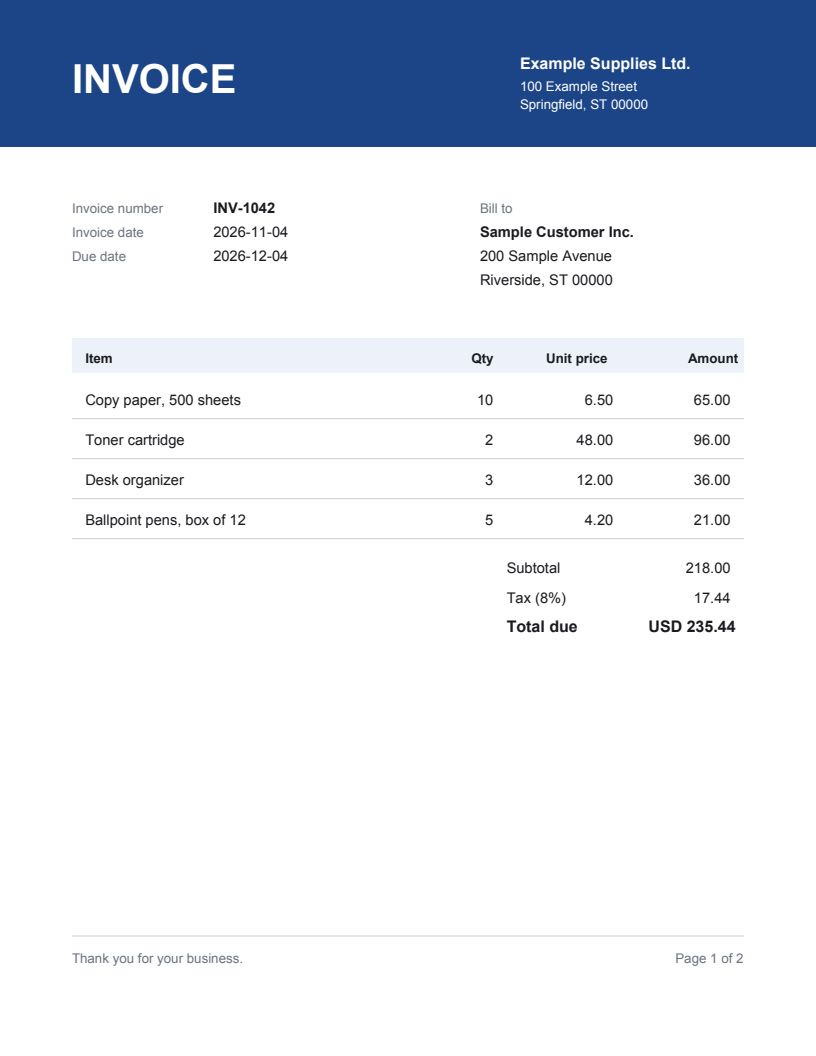
The live demo converts one page at up to 150 DPI, from PDFs up to 2 MB. No API key is needed to try it.
Code Examples
 cURL
 Python
 JavaScript
 Node.js
 PHP
 Go
 Java
 C#
 Ruby
 Swift
# Convert pages of document.pdf; the JSON holds each page as a base64 image
curl -X POST "https://api.api-ninjas.com/v1/pdftoimage?pages=1-3&format=jpg&dpi=150&quality=85" \
  -H "X-Api-Key: YOUR_API_KEY" \
  -F "file=@document.pdf"

# Or save page 1 as a JPG file
curl -X POST "https://api.api-ninjas.com/v1/pdftoimage?pages=1&format=jpg&dpi=150&quality=85" \
  -H "X-Api-Key: YOUR_API_KEY" \
  -H "Accept: image/jpeg" \
  -F "file=@document.pdf" \
  --output page-1.jpg
Errors
An invalid request returns HTTP 400 with a JSON body holding a readable error message, and is not counted against your quota. Authentication and quota errors use the standard format described in error codes.
| Cause | Example error |
|---|---|
| No PDF in the request | Send a PDF as file (a multipart form upload) or as url (a link to the PDF). |
| The file is not a PDF | The file is not a PDF. |
A password-protected PDF without password | This PDF is password-protected. Send its password in the password parameter. |
A wrong password | The password is incorrect for this PDF. |
pages outside the PDF, e.g. pages=5 for a 3-page PDF | pages is outside this PDF, which has 3 pages. |
A pages value that is not a page list | pages must be page numbers or ranges such as 1, 2-5, 1,3,7-9 or 4- (page 4 to the end). |
A format other than jpg, png or webp | format must be jpg, png or webp. |
A number out of range, e.g. dpi=600 | dpi must be between 30 and 300. |
A PDF at url over 25 MB | The PDF at url is larger than 25 MB. |
| One page alone is too large for a response | Page 1 is too large to return at 300 DPI as PNG. Use a lower dpi or format=jpg. |
Frequently Asked Questions
Can I use the PDF to JPG API for commercial purposes?
Yes, but you must have a premium subscription. Commercial use of the PDF to JPG API is not permitted on the free tier. See our pricing page to choose a plan that fits your needs.How do I get an API key and start using the PDF to JPG API?
Sign up for a free account to instantly get your API key, then pass it in theX-Api-Keyheader on every request. The documentation above includes ready-to-run examples in cURL, Python, JavaScript, Node.js, and more.What happens if I exceed my quota for the month?
Your API requests will simply be denied once you hit your monthly quota — you will never be charged more than the plan you signed up for. To increase your quota, you can upgrade your plan any time on our pricing page.What happens if a request to the PDF to JPG API fails?
The API responds with a standard HTTP status code and a JSON error message describing the problem. See our error codes reference for the full list of codes and how to resolve each one, or contact support if you need help.How do I convert PDF to JPG with an API?
Send the PDF to/v1/pdftoimagewithformat=jpg(the default): as a multipart upload namedfile, as the raw request body, or as aurl. For example,curl -X POST "https://api.api-ninjas.com/v1/pdftoimage?pages=1-3&format=jpg" -H "X-Api-Key: YOUR_API_KEY" -F "file=@document.pdf"returns pages 1 to 3 as base64 JPGs in JSON. Add the headerAccept: image/jpegto get the first page as a.jpgfile instead.How do I batch convert PDF pages to JPG?
One request converts up to 10 pages to JPG (fewer at high DPI, as a response carries up to about 4 MB of images). If pages are left over, the response'snext_pagesays where to continue: repeat the request withpages=<next_page>-untilnext_pageisnull. To convert many PDFs, send one request per PDF; requests can run in parallel.What JPG quality should I use?
The defaultquality=85keeps text crisp on screen at a moderate size and suits most uses, including OCR. Use 60 to 75 for thumbnails and previews, where a smaller file matters more than fine detail, and 90 to 95 for printing and archiving. Quality 100 makes much larger files for little visible gain.How large are the JPG files?
For a typical text page atquality=85: about 75 to 120 KB at 72 DPI, 250 to 350 KB at 150 DPI (the default), and 700 to 900 KB at 300 DPI. Pages with photos or dark backgrounds come out larger. Loweringdpisaves far more than loweringquality.Should I convert PDF to JPG or PNG?
JPG for most uses: smaller files, supported everywhere, and good for scans and photos. PNG when text and line art must stay pixel-exact, at a larger file size. Both, plus WebP, are available from the same endpoint; see the PDF to Image API.How many API calls does converting a PDF to JPG use?
Each JPG page returned counts as 10 API calls, so a 3-page PDF counts as 30. Requests that fail are not counted, and theX-Api-Calls-Chargedresponse header shows the count for each request.
Explore API integration use cases for recommended APIs and workflow examples.